Monday, April 27, 2009

Keeping the Military Free

by John Horvat II

If anyone should know how to run the military, it is those who have years of experience at leading men at every echelon in both peace and war. It is these proud Americans who have served our country with honor who are now petitioning the President and members of Congress to keep our military free of the politically-motivated agenda of homosexual right activists and their allies.


Among the 1,115 signatures can be found a former Chairman of the Joint Chiefs of Staff, several Service Chiefs, a number of combat command, theater, and other major U.S. and allied force commanders, together with a Medal of Honor recipient and a thousand other flag and general officers.


The distinguished retired leaders have formed a special association called Flag & General Officers for the Military opposing the opening of military service to avowed homosexuals.

It enjoys solid support among active duty military men and women who recognize its positive effect on recruiting, morale and readiness.


Elaine Donnelly of The Center for Military Readiness is spearheading an effort to stop the repeal of Section 654 of U.S. Code Title 10 that recognizes how homosexuality is incompatible with military service. It recognizes that the military is a "specialized society" that is "fundamentally different from civilian life" that requires a unique code of personal conduct and demands "extraordinary sacrifices, including the ultimate sacrifice, in order to provide for the common defense." It points out how conditions of military life are often "characterized by forced intimacy with little or no privacy."

In an April 15 op-ed piece in The Washington Post, four high-ranking retired military officers questioned the repeal of the law claiming: “Our past experience as military leaders leads us to be greatly concerned about the impact of repeal on morale, discipline, unit cohesion, and overall military readiness.”

Responding to arguments that the American military should be modeled after the Danish, Dutch or Canadian military services that admit homosexuals, the officers pointed out that it is the American military that is the model for the world and the envy of its adversaries, largely because of its cohesiveness, discipline and morale.

“As former senior commanders, we know that the reason for this long-standing envy is the unsurpassed discipline, morale and readiness of our military. The burden should be on proponents of repeal to demonstrate how their initiative would improve these qualities of our armed services. This they cannot do.”

The imposing of a pro-homosexual agenda upon the military would do more than just allow homosexuals to service in the military. Legislation introduced to repeal Section 654 (H.R. 1283) would impose on commanders a radical policy that mandates "nondiscrimination" against "homosexuality, or bisexuality, whether the orientation is real or perceived."

According to the letter to President Obama and Congress, repeal of this law would also prompt many dedicated people to leave the military. Polling by the Military Times revealed in its most recent survey, 10 percent said they would not reenlist if that happened, and 14 percent said they would consider leaving.

In term of numbers, that means a minimum of 228,600 people in the nation’s active-duty, reserve and National Guard forces would be lost. Especially crippling would be the lost of thousands of sergeants, petty officers and experienced mid-grade officers. Recruitment and retention difficulties are also foreseen.

The nation’s security is too precious to be left in the hands of politicians with an idealogical agenda. Rather, it should be left to the people who know what it takes to defend the nation.

Those who want more information about the many things that supporters of the law can do can go to the Center for Military Readiness by clicking this action link: Action Items to Oppose Repeal of Law on Homosexuality in the Military.

April 27: Feast of Saint Peter Armengol, the saint of confidence in Our Lady...

Saint Peter Armengol: Spanish. 13th century.
In his youth,  Peter Armengol was a great sinner.   He even joined a gang of highway robbers. 
But he later converted and joined the Mercedarian Order, where he dedicated the rest of his life to rescuing Catholic prisoners from Muslim jails.
The most memorable part of his life took place on trip to Bejaïa to ransom 18 children from the Muslims.  He didn't have enough money to pay the ransom so he  stayed behind as a pledge until the full sum of the ransom would arrive. 
However, the money for the full ransom did not arrive in time and he was hanged from the gallows.

                 image

(Painting of Our Lady of Confidence)

But his confidence in Our Lady was not mistaken.  She held him in the air so the noose could not do its deadly work. 

Finally, the full ransom money arrived, and Saint Peter was found to be still alive, hanging from the rope.  His confidence in Our Lady had saved him.
But for the rest of his life, he had a huge scar where the rope had been and a twisted neck. 
He died a holy death in 1304.

TFP-America Needs Fatima rosary rally against "Imagine No Religion" billboard in Kansas

042509 pub rosary 014


042509 pub rosary 001


042509 pub rosary 004


042509 pub rosary 011

Saturday, April 25, 2009

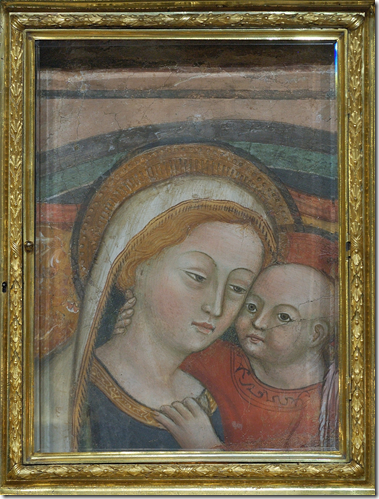
Miraculous fresco hovering in the air since 1467... Our Lady of Good Counsel of Genazzano: Feast Day, April 26

Good Counsel Our Lady

This photo was taken by my friend Kenneth Drake a few weeks ago, of the miraculous fresco of Our Lady of Good Counsel of Genazzano.

Please read the full story of this miraculous fresco of Our Lady that today is venerated in the small town of Genazzano, Italy.

The Story of Our Lady of Genazzano

A view of the town of Genazzano, resting place of the miraculous painting of Our Lady.

A few miles from the city of Rome, lies Genazzano—a city rich in history and blessed with the presence of a miraculous painting of the Blessed Virgin that has an amazing story.

The origins of Genazzano date back to the times of the Roman emperors. Because of its proximity to Rome, the city was chosen by many patricians and imperial courtiers as a site for their country villas. The vast gardens surrounding these villas often served as the stage for perverse feasts, pagan games and heathen rituals in honor of the gods to whom the Romans attributed the fertility of their fields.

One of these celebrations was held every April 25 in honor of the goddess Flora or Venus. For this event, people of all social classes—freemen and slaves, patricians and plebeians—gathered together for a great feast. This practice gradually dissolved and the temples fell into ruins as the life-giving breath of Christianity regenerated the peoples of Europe.

In the third century, an order was given to build a shrine dedicated to the Mother of God under the tender invocation of Mother of Good Counsel on the ruins of the Roman temples.

As the years went by, the city became more populous and the shrine grew in fame. During the Middle Ages, the Franciscans and the Augustinians founded monasteries nearby. With the passing of years, the primitive temple erected in honor of the Mother of Good Counsel began to show signs of disrepair. Moreover, as the shrine was small, the faithful built larger and richer churches for their solemn functions.

In 1356, about a century before the appearance of the miraculous painting that would introduce Genazzano into the annals of marvels in the Church, Prince Pietro Giordan Colonna, whose family had acquired lordship of the city, assigned the most ancient church of the city and its parish to the care of the Hermits of St. Augustine. The faithful would thereby have the necessary pastoral assistance, and repairs could be made on the old church.

Although the prayers of the faithful intensified, financial difficulties prevented the necessary and urgent restoration of the ancient temple. But the Mother who gives wise counsel in every circumstance and attentively provides for the necessities of men chose a Third Order Augustinian, Petruccia de Nocera, to carry out a supernatural prodigy that would bring about the much-desired restoration.

Petruccia had been left a modest fortune following the death of her husband in 1436. Living alone, she dedicated most of her time to prayer and services in the church of the Mother of Good Counsel. It grieved her to see the deplorable state of the sacred premises, and she prayed fervently that they would be restored. Finally, she resolved to take the initiative. After obtaining permission from the friars, she donated her goods to initiate the restoration in the hope that others would help complete it once it was commenced.

A plan was drawn up for the building of a magnificent church. However, once that arduous undertaking had begun, Petruccia, who was already eighty years old, found that her generous offering was scarcely enough to complete the first phase of the new construction. To make matters worse, no one came forth to help.

To her dismay, the building had hardly risen three feet when construction came to a halt due to lack of resources. Her friends and neighbors began to ridicule her, and detractors accused her of imprudence. Others severely reprimanded her in public. To all of them she would say: "My dear children, do not put too much importance on this apparent misfortune. I assure you that before my death the Blessed Virgin and our holy father Augustine will finish the church begun by me."

On April 25, 1467, the feast day of the city's patron, Saint Mark, a solemn celebration began with Mass. It was Saturday, and the crowd began to gather in front of the church of the Mother of Good Counsel. The only discrepant note in the celebration was the unfinished work of Petruccia.

At about four in the afternoon, everyone heard the chords of a beautiful melody that seemed to come from heaven. The people looked up toward the towers of the churches and saw a white cloud that shone with a thousand luminous rays; it gradually neared the stupefied crowd to the sound of an exceptionally beautiful melody. The cloud descended on the church of the Mother of Good Counsel and poised over the wall of the unfinished chapel of Saint Biagio, which Petruccia had started.

The miraculous image of Our Lady of Genazzano.

Suddenly, the bells of the old tower began to ring by themselves, and the other bells of the town rang miraculously in unison. The rays that emanated from the little cloud faded away, and the cloud itself gradually vanished, revealing a beautiful object to the enchanted gaze of the spectators. It was a painting that represented Our Lady tenderly holding her Divine Son in her arms. Almost immediately, the Virgin Mary began to cure the sick and grant countless consolations, the memory of which was recorded for posterity by the local ecclesiastical authority.

The news of the painting and its miracles spread throughout the province and beyond, attracting multitudes. Some cities formed enthusiastic processions to see the picture that the people called the Madonna of Paradise because of its celestial entrance into the city. Numerous alms were donated as an answer to the unwavering confidence that Our Lady had inspired in Petruccia.

Amidst the general enthusiasm caused by the painting, Our Lady wished to divulge the true origin of the marvelous fresco to her devotees. Two foreigners named Giorgio and De Sclavis entered the city among a group of pilgrims that had come from Rome. They wore strange clothes and spoke a foreign tongue, saying they had arrived in Rome earlier that year from Albania. While most people had refused to believe their story, it had a special significance for the inhabitants of Genazzano.

*****

January of 1467 saw the death of the last great Albanian leader, George Castriota, better known as Scanderbeg. Raised by an Albanian chief, he placed himself at the head of his own people. Subsequently, Scanderbeg inflicted stunning defeats on the Turkish army and occupied fortresses all over Albania.

With Scanderbeg’s death, the Turkish army, finally free from the Fulminating Lion of War, poured into Albania, occupying all its fortresses, cities and provinces with the exception of Scutari, in the north of the country.

However, the city's capacity to resist was limited, and its capture was expected at any moment. With its fall, Christian Albania would be defeated. Faced with this prospect, those who wished to practice their faith in Christian lands began a sad exodus. Giorgio and De Sclavis also studied the possibility of fleeing, but something kept them in Scutari, where there was a small church, considered the shrine of the whole Albanian kingdom. In this church the faithful venerated a picture of Our Lady which had mysteriously descended from the heavens two hundred years before.

According to tradition, it had come from the east. Having poured out innumerable graces over the whole population, its church became the principal center of pilgrimage in Albania. Scanderbeg himself had visited this shrine more than once to ardently ask for victory in battle. Now the shrine was threatened with imminent destruction and profanation.

The two Albanians were torn by the idea of leaving the great treasure of Albania in the hands of the enemy in order to flee the Turkish terror. In their perplexity, they went to the old church to ask their Blessed Mother for the good counsel they needed.

That night, the Consoler of the Afflicted inspired both of them in their sleep. She commanded them to prepare to leave their country, which they would never see again. She added that the miraculous fresco was also going to leave Scutari for another country to escape profanation at the hands of the Turks. Finally, she ordered them to follow the painting wherever it went.

The next morning, the two friends went to the shrine. At a certain moment they saw the picture detach itself from the wall on which it had hung for two centuries. Leaving its niche, it hovered for a moment and was then suddenly wrapped in a white cloud through which the image continued to be visible.

The pilgrim painting left the church and the environs of Scutari. It traveled slowly through the air at a considerable altitude and advanced in the direction of the Adriatic Sea at a speed that allowed the two walkers to follow; after covering some twenty-four miles, they reached the coast.

With unbounded confidence, Giorgio and De Scalvis walked on the waves of the Adriatic Sea.

Without stopping, the picture left the land and advanced over the waters while the faithful Giorgio and De Sclavis continued to follow, walking on the waves much like their Divine Master had done on Lake Genesareth. When night would fall, the mysterious cloud, which had protected them with its shade from the heat of the sun during the day, guided them by night with light, like the column of fire in the desert that guided the Jews in their exodus from Egypt.

They traveled day and night until they reached the Italian coast. There, they continued following the miraculous picture, climbing mountains, fording rivers and passing through valleys. Finally, they reached the vast plain of Lazio from where they could see the towers and domes of Rome. Upon reaching the gates of the city, the cloud suddenly disappeared before their disappointed eyes.

Giorgio and De Sclavis began to search the city, going from church to church asking if the painting had descended there. All their attempts to find the painting failed, and the Romans incredulously regarded the two foreigners and their strange tale.

Shortly thereafter, amazing news came to Rome: a picture of Our Lady had appeared in the skies of Genazzano to the sound of beautiful music and had come to rest over the wall of a church that was being rebuilt. The two Albanians rushed to find their country's beloved treasure miraculously suspended in the air next to the wall of the chapel where it remains to this day.

Although some inhabitants found the strangers' story difficult to believe, careful investigation later proved that the two were telling the truth and that the image was indeed the same one that graced the shrine in Scutari.

*****

Thus Mary Most Holy, with the humble participation of a pious Third Order Augustinian on one side of the Adriatic and two faithful Albanians on the other, transported her mysterious fresco from the unhappy and unfortunate Albania to a little city very close to the heart of Christendom. Beginning her historic journey from that small Albanian shrine, which she had not chosen by chance, she traveled across the sea to pour on the world a new torrent of graces under the invocation of Mother of Good Counsel.


To locate information on a specific topic, enter keywords or phrase above.

Join the Crusade!
If you liked this article, you will want to subscribe to Crusade Magazine. It's easy to subscribe. Just click here

Send To Friend | Contact Us | Privacy Policy | Search | Top Of Page | Site Map
© 2007 by the American TFP. All rights reserved.


Searching for heaven; the souls of the builders of the Middle Ages

For the medieval mind, this earth was a place of exile in which there was a paradise: the Holy Catholic Church, the only true church of the only true God.  And the stained glass windows were the windows of this paradise. 

 
The  Romans discovered the window, but they never made stained glass windows.
When did stained glass start?
When the desire for the marvelous started.
If the souls of the stained glass makers were not searching for this blue, green and gold, would they have taken the trouble to discover them?

 
They preferred to live a life of semi-poverty to find that perfect blue or green for a stained glass window of Our Lady, Saint Gabriel, or some other saint.
Afterward, they died happily: "Our Lady now has a perfect blue color in her stained glass window.  This is my contribution that will remain forever for Her glory."
And we would like to imagine that the angel that came to take their soul at death had the holiness and virtue to match the color of their dream. 
This was the death of an artisan who made the stained glass window.
 
He could say:
"My life has meaning and purpose; I made this color known to men, to the piety of the Church, for the glory of Our Lady in a certain mystery of Her life.  O sun!  You were created before me, but you were also made so one day your rays would cross my window.  For as long as you exist, for as long as the world exists, a ray of yours will cross the blue of my dreams, and brighten the granite floor and lift up the soul of some faithful that sees it.  My life is explained."
Behind the history of the stained glass window is the story of the souls that desired these colors.
But there's more.

It is the history of a family of souls that desired something marvelous that was far more universal than one color.   They desired the complete stained glass window. 

And above them were the souls who thought of the cathedral.

Why -- is not the stained glass window just part of the cathedral? 

The stained glass windows are the 'eyes' of the cathedral, if you will.
The soul of the Middle Ages that thought of the cathedrals and castles desired more, more and more.
When was this soul born?
When was the soul and spirit of the Middle Ages born?
We row up the river of Church history when we ask ourselves these questions.

All these souls who engendered the gothic, desired always more, more and more perfect things. 

And the day will come when the perfection of the Church and Christian Civilization will reach such a height that the Reign of Mary will be established on earth. 

And, therefore, art and culture, and the stained glass windows, plus many other things, will flourish and excel like never before.
We are in an era where the Reign of Mary is germinating.
To know what the Reign of Mary will be like, we should try to feel it pulsating in our souls and not so much try to plan or organize it.
(Taken from: http://tudosobreidademedia.blogspot.com/2008_04_01_archive.html.  Originally, from a lecture by Plínio Correa de Oliveira.  The translation is my own and it was not revised by the author. )

Video of Mass Celebrated by Lithuanian Bishop Eugenius Bartulis; 100 years of Prof. Plinio Correa de Oliveira

See video of the Mass here:

http://es.gloria.tv/?media=25441

On 12-13-2008, centennial of the birth of Plinio Corrêa de Oliveira
the Lithuanian Bishop of Siauliai, Msgr. Eugenius Bartulis, celebrated a solemn Latin Mass at the Church of the Sacred Heart of Jesus in downtown São Paulo, Brazil.

He was assisted by Msgr. Gilles Wach, founder and prior-general of the Institute Christ the King Sovereign Priest.  Many other priests were present.

This video shows some footage of the celebration.

The standards and capes displayed by some of those present at the commemorations of the centennial of the birth of the Brazilian Catholic leader and intellectual (*12-13-1908 +10-3-1995) are symbols of the foreign associations they are affiliated with, and not of any Brazilian entity.

Saint Therese & Wholesome Regionalism & Leveling Cosmopolitanism

by Plinio Corrêa de Oliveira

Saint Theresa as a young lady, wearing the fashions of Paris of her times.

The following text is taken from an informal lecture Professor Plinio Corrêa de Oliveira gave on December 10, 1970. It has been translated and adapted for publication without his revision. – Ed.


There is an interesting passage in Saint Theresa’s famous Story of a Soul, in which she speaks of the cultural atmosphere that existed in Loreto when, as a child, she went on pilgrimage with her family:

I was indeed happy when on the way to Loreto. Our Lady has chosen an ideal spot in which to place her Holy House. Everything is poor, simple, and primitive; the women still wear the graceful dress of the country and have not, as in the large towns, adopted the modern Paris fashions. I found Loreto enchanting. And what shall I say of the Holy House? I was overwhelmed with emotion when I realized that I was under the very roof that had sheltered the Holy Family.[1]

This excerpt gives one a small taste of the sublime atmosphere the Holy House of Loreto created around itself. Furthermore, one perceives that the graces brought by the Holy House also formed the souls and customs of the local population.
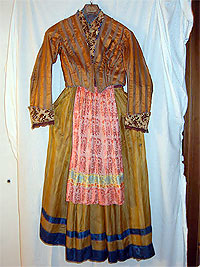
At that time, traditional clothing was still worn by the people in many regions of Europe, and Saint Theresa opines that the local ladies did well to conserve their traditional dress.

A regional dress from Calabria, Italy.

She eulogizes the women for using the simple clothing of a bygone era, rather than wearing the latest Paris fashions. She believes that healthy regionalism is preferable to cosmopolitanism. This is a Counter-revolutionary position in face of the Revolution’s[2] efforts to finish with regional characteristics.

In this, Saint Theresa’s profoundly Counter-revolutionary soul shows itself. Her understanding of the correlation between temporal and spiritual life becomes manifest. She realizes that a good social organization favors the practice of virtue and sanctification. All this is contained in this small but dense excerpt.
Ironically, when she wrote this, certainly she was wearing Parisian fashions, since in France, only country girls wore regional clothing.

While modest, Paris’ fashions favored the leveling effect of cosmopolitanism. Observing the ladies in Loreto, she perceived this, and expressed her love of legitimate regional differences, even while she resigned herself to wearing the chaste clothing, common to her status.

Footnotes:

  1. T.N. Taylor, ed., Soeur Thérèse of Lisieux, The Little Flower of Jesus (New York: P.J. Kennedy and Sons, 1924), pp. 93-94.
  2. The terms “Revolution” and “Counter-revolution” are used here in the sense explained by Prof. Plinio Corrêa de Oliveira in his book, Revolution and Counter-Revolution. In this context the “Revolution” is a five-centuries-old process that seeks to destroy Christian civilization, especially through temporal society. The Counter-revolution, then, is made up of those willing to resist this process of de-Christianization.