Thursday, February 20, 2014

St. Peter Damian – The Saint Who Was Unafraid to Denounce the Homosexual Lobby

St. Peter Damian

Doctor of the Church, Cardinal-Bishop of Ostia, born at Ravenna “five years after the death of the Emperor Otto III,” 1007; died at Faenza, 21 Feb., 1072.

He was the youngest of a large family. His parents were noble, but poor. At his birth an elder brother protested against this new charge on the resources of the family with such effect that his mother refused to suckle him and the babe nearly died. A family retainer, however, fed the starving child and by example and reproaches recalled his mother to her duty.

Left an orphan in early years, he was at first adopted by an elder brother, who ill-treated and under-fed him while employing him as a swineherd. The child showed signs of great piety and of remarkable intellectual gifts, and after some years of this servitude another brother, who was archpriest at Ravenna, had pity on him and took him away to be educated. This brother was called Damian and it was generally accepted that St. Peter added this name to his own in grateful recognition of his brother’s kindness.

He made rapid progress in his studies, first at Ravenna, then at Faenza, finally at the University of Parma, and when about twenty-five years old was already a famous teacher at Parma and Ravenna. But, though even then much given to fasting and to other mortifications, he could not endure the scandals and distractions of university life and decided (about 1035) to retire from the world. While meditating on his resolution he encountered two hermits of Fonte-Avellana, was charmed with their spirituality and detachment, and desired to join them.

Encouraged by them Peter, after a forty days’ retreat in a small cell, left his friends secretly and made his way to the hermitage of Fonte-Avellana. Here he was received, and, to his surprise, clothed at once with the monastic habit.

Monastery di Fonte Avellana

Monastery di Fonte Avellana

Both as novice and as professed religious his fervour was remarkable and led him to such extremes of penance that, for a time, his health was affected. He occupied his convalescence with a thorough study of Holy Scripture and, on his recovery, was appointed to lecture to his fellow-monks. At the request of Guy of Pomposa and other heads of neighbouring monasteries, for two or three years he lectured to their subjects also, and (about 1042) wrote the life of St. Romuald for the monks of Pietrapertosa. Soon after his return to Fonte-Avellana he was appointed economus of the house by the prior, who also pointed him out as his successor.

This, in fact, he became in 1043, and he remained prior of Fonte-Avellana till his death. His priorate was characterized by a wise moderation of the rule, as well as by the foundation of subject-hermitages at San Severino, Gamugno, Acerata, Murciana, San Salvatore, Sitria, and Ocri. It was remarkable, too, for the introduction of the regular use of the discipline, a penitential exercise which he induced the great abbey of Monte Cassino to imitate. there was much opposition outside his own circle to this practice, but Peter’s persistent advocacy ensured its acceptance to such an extent that he was obliged later to moderate the imprudent zeal of some of his own hermits. another innovation was that of the daily siesta, to make up for the fatigue of the night office.

During his tenure of the priorate a cloister was built, silver chalices and a silver processional cross were purchased, and many books added to the library.

St. Peter Damian

Although living in the seclusion of the cloister, Peter Damian watched closely the fortunes of the Church, and like his friend Hildebrand, the future Gregory VII, he strove for her purification in those deplorable times. In 1045 when Benedict IX resigned the supreme pontificate into the hands of the archpriest John Gratian (Gregory VI), Peter hailed the change with joy and wrote to the pope, urging him to deal with the scandals of the church in Italy, especially with the evil bishops of Pesaro, of Citta di Castello, and of Fano.

He was present in Rome when Clement II crowned Henry III and his wife Agnes, and he also attended a synod held at the Lateran in the first days of 1047, in which decrees were passed against simony. After this he returned to his hermitage. Pope St. Leo IX was solemnly enthroned at Rome, 12 Feb., 1049, to succeed Damasus II, and about two years later Peter published his terrible treatise on the vices of the clergy, the “Liber Gomorrhianus”, dedicating it to the pope. It caused a great stir and aroused not a little enmity against its author. Even the pope, who had at first praised the work, was persuaded that it was exaggerated and his coldness drew from Damian a vigorous letter of protest.

Liber Gomorrhianus

Liber Gomorrhianus

Meanwhile the question arose as to the validity of the ordinations of simoniacal clerics. The prior of Fonte-Avellana was appealed to and wrote (about 1053) a treatise, the “Liber Gratissimus”, in favour of their validity, a work which, though much combatted at the time, was potent in deciding the question in their favour before the end of the twelfth century. In June, 1055, during the pontificate of Victor II, Damian attended a synod held at Florence, where simony and clerical incontinence were once more condemned. About two years later he fell ill at Fonte-Avellana and nearly died, but suddenly, after seven weeks of pain, recovered, as he believed, through a miracle.

During his illness the pope died, and Frederic, abbot of Monte Cassino, was elected as Stephen X. In the autumn of 1057, Stephen X determined to create Damian a cardinal. For a long time he resisted the offer, but was finally forced, under threat of excommunication, to accept, and was consecrated Cardinal-Bishop of Ostia on 30 Nov., 1057. In addition he was appointed administrator of the Diocese of Gubbio. The new cardinal was impressed with the great responsibilities of his office and wrote a stirring letter to his brother-cardinals, exhorting them to shine by their example before all. Four months later Pope Stephen died at Florence and the Church was once more distracted by schism. The Cardinal of Ostia was vigorous in his opposition to the antipope Benedict X, but force was on the side of the intruder and Damian retired to Fonte-Avallana.

Monastery Ossiach - Celling-painting: Virgin Mary is appearing to Cardinal Petrus Damiani - Painter: Josef Ferdinand Fromiller

Monastery Ossiach – Celling-painting: Virgin Mary is appearing to Cardinal Petrus Damiani – Painter: Josef Ferdinand Fromiller

About the end of the year 1059 Peter was sent as legate to Milan by Nicholas II. The Church at Milan had been, for some time, the prey of simony and incontinence. So bad was the state of things, that benefices were openly bought and sold and the clergy publicly “married” the women they lived with. But the faithful of Milan, led by St. Ariald the Deacon and St. Anselm, Bishop of Lucca, strove hard to remedy these evils. At length the contest between the two parties became so bitter that an appeal was made to the Holy See to decide the matter. Nicholas II sent Damian and the Bishop of Lucca as his legates.

But now the party of the irregular clerics took alarm and raised the cry that Rome had no authority over Milan. At once Peter took action. Boldly confronting the rioters in the cathedral, he proved to them the authority of the Holy See with such effect that all parties submitted to his decision. He exacted first a solemn oath from the archbishop and all his clergy that for the future no preferment should be paid for; then, imposing a penance on all who had been guilty, he re-instated in their benefices all who undertook to live continently. This prudent decision was attacked by some of the rigourists at Rome, but was not reversed. Unfortunately, on the death of Nicholas II, the same disputes broke out; nor were they finally settled till after the martyrdom of St. Ariald in 1066. Meanwhile Peter was in vain pleading to be released from the cares of his office. Neither Nicholas II nor Hildebrand would consent to spare him.

The body of St. Peter Damian at the Cathedral of Faenza.

The body of St. Peter Damian at the Cathedral of Faenza.

In July, 1061, the pope died and once more a schism ensued. Damian used all his powers to persuade the antipope Cadalous to withdraw, but to no purpose. Finally Hanno, the Regent of Germany, summoned a council at Augsburg at which a long argument by St. Peter Damian was read and greatly contributed to the decision in favour of Alexander II. In 1063 the pope held a synod at Rome, at which Damian was appointed legate to settle the dispute between the Abbey of Cluny and the Bishop of Mâcon.

He proceeded to France, summoned a council at Chalon-sur-Saône, proved the justice of the contentions of Cluny, settled other questions at issue in the Church of France, and returned in the autumn to Fonte-Avellana. While he was in France the antipope Cadalous had again become active in his attempts to gain Rome, and Damian brought upon himself a sharp reproof from Alexander and Hildebrand for twice imprudently appealing to the royal power to judge the case anew. In 1067 the cardinal was sent to Florence to settle the dispute between the bishop and the monks of Vallombrosa, who accused the former of simony.

His efforts, however, were not successful, largely because he misjudged the case and threw the weight of his authority on the side of the bishop. The matter was not settled till the following year by the pope in person. In 1069 Damian went as the pope’s legate to Germany to prevent King Henry from repudiating his wife Bertha. This task he accomplished at a council at Frankfort and returned to Fonte-Avellana, were he was left in peace for two years.

Early in 1072 he was sent to Ravenna to reconcile its inhabitants to the Holy See, they having been excommunicated for supporting their archbishop in his adhesion to the schism of Cadalous. On his return thence he was seized with fever near Faenza. He lay ill for a week at the monastery of Santa Maria degl’Angeli, now Santa Maria Vecchia. On the night preceding the feast of the Chair of St. Peter at Antioch, he ordered the office of the feast to be recited and at the end of the Lauds he died. He was at once buried in the monastery church, lest others should claim his relics. Six times has his body been translated, each time to a more splendid resting-place.

It now lies in a chapel dedicated to the saint in the cathedral of Faenza in 1898. No formal canonization ever took place, but his cultas has existed since his death at Faenza, at Fonte-Avellana, at Monte Cassino, and at Cluny. In 1823 Leo XII extended his feast (23 Feb.) to the whole Church and pronounced him a Doctor of the Church. The saint is represented in art as a cardinal bearing a discipline in his hand; also sometimes he is depicted as a pilgrim holding a papal Bull, to signify his many legations.
Subscription24

Acta SS. Boll., III, Feb. (Venice, 1736), 406-27; BIRON, St. Pierre Damien, 1007-72 (Paris, 1908); CAPECELATRO, Storia di San Pier Damiano (Rome, 1887); KLEINERMANNS, Der heilige Petrus Damiani (Steyl, 1882); LADERCHI, Vita S. Petri Damiani (3 vols., Rome, 1702); MABILLON, Acta SS. O.S.B., S=E6c. VI, P. ii (Venice, 1733), 253-273; MARTIN, Saint L=E9on IX 1002-54 (Paris, 1904); MIGNE, Dictionnaire de Patrologie, V (Paris, 1864), 959-1000; P.L.., CXLIV, CXLV (Paris, 1867); MITTAREELLI ET COSTADONI, Annales Camaldulenses, II (Venice, 1756), 40-359; NEUKIRCH, Das Leben des Petrus Damiani=85bis zur=851059 (Göttingen, 1875); PF=DCLF, Damiani=92s Zwist mit Hildebrand in Stimmen aus Maria-Laach, XLI (1891), 281-307, 400-416, 508-525; ROTH, Der heilige Petrus Damiani, O.S.B., in Studien O.S.B., VII (1886), i, 110-134; ii, 357-374; iii, 43-66; iv, 321-336; VIII (1887), i, 56-64; ii, 210-216.

LESLIE A. ST. L. TOKE (Catholic Encyclopedia)

___________________________

S. Peter Damian's parents were noble but poor. There is a lesson here for us today submerged as we are in a world that worships at the altar of Mammon and despises those who cannot command great wealth.

The medieval world was governed by a different criteria. While money was important, it had its place, and it was not topmost. Honor, valor, loyalty were the paramount values in medieval society. These were the virtues that the nobility most sought after, and consequently, medieval society prized the noble condition much more than the bourgeois one, even if members of the bourgeoisie possessed abundant wealth.

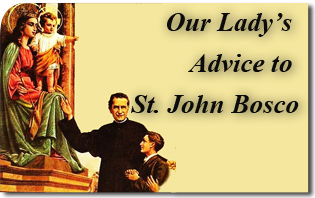
Our Lady’s Advice to Saint John Bosco

Our Lady's Advice to Saint John Bosco

Saint John Bosco
recounts a vision in which
the Blessed Mother
emphasizes how important
youth education is, as well
as its inherent dangers

We must not worry about appearances when it comes to what people may think of us when doing our duty.

The great Saint John Bosco, founder of the Salesian Congregation, disclosed to a small group of friends an important supernatural vision he had.  A priest in attendance took note of his words, which we transcribe below:

One day in the year 1847 the Queen of Heaven appeared to me and led me to a lovely garden.  A gorgeous porch opened onto a beautiful avenue which prolonged, with a broad perspective, an alley worth seeing, flanked by and covered with marvelous roses in full bloom.  The ground was completely covered with roses.  The Blessed Virgin told me: “Take off your shoes.” After I had done it, she added: “Go ahead down that alley; that is the way you should go.”

I started walking but suddenly realized that these flowers concealed extremely sharp thorns, to the point that my feet began to bleed. After taking a few steps, I had to turn back. “At this point I need shoes,” I told my guide. “Of course,” she replied.

I put my shoes on and kept walking down that way with a number of friends who appeared at that very moment, asking to walk with me.

Meanwhile, all those friends – they were very many – watched me walk on the rose bushes and said: “Wow!  Look how Don Bosco walks always well over the roses!  And how tranquil he remains! For him, everything is easy.” They did not see the thorns tearing up my poor feet.

Many clerics, priests and laity, whom I had invited, were pleased to follow me, attracted by the beauty of those flowers.  But as soon as they realized they would be walking on thorns, they retreated and left me alone.  However, I took comfort in the arrival of a new group of excited followers who, having traveled with me all the way down the alley finally arrived at another extremely pleasant garden.

Then the Blessed Virgin Mary — my guide — asked me: “Do you know the meaning of what you have just seen?”  I answered. “I beg you to explain it to me.”  “You should know that the path you have walked among roses and thorns symbolizes the care you must take of the youth; you must walk in the shoes of mortification.

The thorns on the ground represent the sensitive human affections, sympathies and antipathies that divert a teacher from his true goal, hurt him, hinder his mission and prevent him from forming and reaping wreathes for eternal life.  Roses are the symbol of the ardent charity by which you and your associates must distinguish yourselves. The thorns symbolize the obstacles, sufferings and sorrows that await you.  But do not lose heart.  With charity and mortification you will overcome everything and will have roses without thorns!”

As soon as the Mother of God finished speaking, I came to and found myself in my room.(*)

For starters, it is interesting to note that it is Our Lady who points the way to the saint. She does not say: “Go wherever you want,” but shows him the right path, for God has chosen a path for each one of us; a path which, if we are faithful, we must tread all the way to the end.
Saint John Bosco prays to Our Lady Help of Christians

In the case of Don Bosco, his path was not without many crosses and suffering, symbolized by the thorns that afflicted the great saint. In our earthly life, God wants us to face and overcome obstacles in order to sanctify ourselves and gain merits for Heaven.

As one can see from the words of the saint, people can sometimes wrongly assess the situation of others, seeing only roses and no thorns. In any case, what matters is not the concept that others have of us but what we do before God, Who judges our right intention regardless of what others may think.

Thus, while giving alms to the needy is of itself a good deed, anyone can do it for ostentation instead.

The final comment of the Mother of God is symptomatic in this regard. She warns Saint John Bosco about the dangers inherent to his well-deserving activity of educating the young. Indeed, educators can have attachments, preferences, ulterior motives, dislikes, and so forth. However, when doing something for the love of God, the latter must be our sole motivation, without mixing emotions and movements of the soul that distract us from that love, depriving us of the merits we would gain for our actions.

It is worth noting that Our Lady promises happiness — the rose without thorns — but only at the end. In this earthly life we will face greater or lesser problems and sufferings. Perfect happiness is attained only in the eternal life, for which we must constantly prepare ourselves. Let us emulate Saint John Bosco by doing what God asks of us with courage and perseverance: we will not lack the means to do it. And finally, we will receive the prize that Our Lady has prepared for us: eternal bliss.

(*)  Juan B. Lemoyne, Vida de San Juan Bosco, Ed. Don Bosco, Buenos Aires, 1954, pp. 170-172.

Wednesday, February 19, 2014

Lenten Fast From Technology: 13 Tips to Regain Spiritual Control of Your Life

Technology can be compared to a wild bronco.  If not kept strictly in its place, it can easily spill its rider.

File:Plunging bronco, Bar Diamond Bar range.jpg

The human race is inundated with technology –– especially computer technology.  It’s a huge part of our lives.  Today, almost everything depends on it. But too often, we become the servant, and technology the master.

However, to wholly condemn technology is an overreaction. Technology is here to serve us, and it can serve us well as long as we are careful. What we must do is learn to temper our use of technology so we can regain control of our lives.

This Lent, there are 3 vital things to keep in mind:

1. You must regain control over the technology in your life. You should be in charge of technology, not the other way around.

2. Be realistic about what technology can really do to improve your life.  Remember: technology should be a means to an end––not an end in itself.

3. You must protect yourself from the brutal pace of life brought on by modern technology.  Don’t let technology and speed rob you of your humanity.

13 Tips for Reigning in Technology And Regaining Control of Your Life

The fascinating book Return to Order offers a roadmap to an organic Christian Society, where technology is the servant, not the master.

1. The right way to start the day: After waking, read or reflect on something that lifts your mind to the higher aspects and realities of life. It should be something that captivates your unique personal aspirations––something that gives you food for lively and refreshing thoughts throughout the day.

You can begin with a short reading or meditation. This contemplative activity must capture and engage your imagination in a manner that fosters calm pondering and is pleasurable, enduring and rewarding. Choose something you will enjoy reading or meditating on, something that fits your personality and way of being, so that you can do this day after day, week after week and month after month.

Once this thoughtful reading or meditation becomes a habit, you’ll have a true “forest” of wisdom to pull from whenever you hit a rough spot. If you find this too difficult, it is a telltale sign that technology is precariously leading you, as if you are a rider who has fallen from the saddle and is being dragged from the stirrup by the horse.

2. The shoe box solution: Share old items and keepsakes with family members, especially with your children. These are things handed down from your ancestors, clippings from historic events that shaped their lives or even such things as a baptismal certificate or your parent’s wedding photos.

Scrap booking is very popular because it offers meaningful time with family and friends looking at old photos together. Even if the pictures are in an old shoe box it’s still fun to go through them with others. The shoe box solution is much more “human” than the Facebook because the sharing of memories happens in the same room and involves things Facebook cannot communicate––body language, a smile, an infectious laugh, a hug. Looking at these family relics restores to your soul an idea of connectedness and a reminder of where you came from, who your ancestors were, their traits and achievements, their lifestyles and traditions, etc.

3. Quality time offline: Carve out quality time in your day when you are completely unplugged from radio, television, Internet, MP3 player, smart phone, etc. Try doing this for at least one hour in the morning and three hours before you go to sleep. If you are unable to stay away from technology for this length of time, start weaning yourself off it in smaller increments of 15 or 30 minutes at a time. If even this is not possible, you may consider going on a weekend fast from all technology so you can regain control over your technology use.

4. Reading aloud: Spend 10 to 15 minutes reading aloud. Let the concepts from each sentence sink into your mind in an ordered and cadenced manner. Don’t feel bad if you need to reread the paragraph for the concept to become part of you. Remember: if you cannot explain it, you really don’t know it. This practice not only helps you retain what you read, but it increases your attention span, which may have been damaged by multitasking.

5. A calm evening practice: In the evening, do something that engages the mind, calms the emotions and focuses the attention on one single thing for a period of 30 minutes to an hour. Try not to let your attention wander and flit from one thing to the next. For example, handwrite a letter to a friend or family member you have not heard from in a while. Use a fountain pen. Write on quality paper. Use a crisp, clean envelope.

Or, try writing a journal entry or spending time doing a hobby that involves the act of creation, imitation and the striving for perfection. Another idea is to listen to a piece of classical music––preferably Mozart, Hayden or Bach. Close your eyes and think about what you are hearing and how it touches your soul.

6. Notice and appreciate surroundings: Go for a walk in a park or wooded area without your smart phone. Even better, walk along the seashore if you live near the ocean. Pay attention to the things around you: the smells of the salty breeze, the seagulls flying about, the ebbs and flows of the waves––but all without overworking your mind. Do it calmly and for a moderate amount of time. If you feel inspired, write down some of your reflections after you walk.

7. Silence is golden: Once a week, go to church and pray in silence for 10 to 15 minutes. If nothing comes to mind to pray for, spend time in silence. You don’t absolutely need to pray, but you can gain from simply opening your soul and listening to God, who silently speaks to your interior. Write your impressions down, but only if you feel so inclined. Don’t prolong the experience beyond that certain point of balance and normal endurance. If you do, this marvelous experience could turn into something boring or forced.

8. Reflection is refreshing: Don’t be afraid to think about the big questions of life that all human beings ask. Are there things you wonder about for which you have no answers? For example, why did God create ugly creatures? To heighten the contrast with beautiful ones? Or, why do some notorious and public bad fellows seem to have an easy and carefree life, while other evidently honest folks experience tremendous hardships? Not all such issues need to be strictly spiritual. Natural and metaphysical ponderings can also be very helpful and lead to the understanding of higher, supernatural realities. For example, do you enjoy looking at the ocean? What does its beauty symbolize? What metaphysical qualities does it have? In what way can these qualities remind us of God?

The fascinating book Return to Order offers a roadmap to an organic Christian Society, where technology is the servant, not the master.

9. “Dr. Google” can wait: When you are in a conversation with friends and information is missing on the topic under discussion, don’t immediately reach for your smart phone and do a Google search for the piece of information at question. Rather, try to first search your memory to see if you can solve the problem through deduction, an effort of memory or by looking at the problem from a completely different perspective. Or, look at the premise of the discussion. Perhaps the very premise of the debate is badly laid out and is the obstacle to reaching a satisfactory answer. If, after this, an answer is not immediately forthcoming, let the issue brew in your mind for a while. Ask older, wiser people if they know of a solution. Finally, if all else fails, look at a qualified book or encyclopedia on the issue. Avoid consulting “Dr. Google” immediately for a quick-fix solution, which often is just as immediately forgotten.

10. Control smart phone usage: Leave your smart phone in the car while having a meal at a restaurant with family or friends and ask others at the meal to do the same. Don’t answer your phone in the midst of a conversation with friends, at a business meeting or conference, and especially not in church! If you can, turn off the ringer so you won’t be tempted to answer your phone––unless, of course, there is an emergency. By answering your phone, tweet or email at these times, you send a powerful, very real, nonverbal message to those around you that they are of little worth. Moreover, you break the unity of thought, focus and purpose of your group. Once broken, this unity is difficult, if not impossible, to reestablish in the short period that follows the interruption.

11. Enjoy the higher pleasures: Don’t be fooled into thinking pleasure is always directly related to physical sensation. Life’s greatest pleasures by far come from the higher things of the soul, the cultural and spiritual experiences that lift the spirit to a higher realm of reality, such as a good conversation with friends, a refined piece of music, a pious moment of prayer, the enjoyment that comes with sacrificing to help a neighbor in time of need. Once a week, go to a concert of classical music, listen to Gregorian Chant, look at a fish tank, join a discussion club, engage in a fireside gathering with family where you pray, read or simply enjoy one another’s informal company.

12. A tech-free Sunday: Plan your Sunday with meaningful activity. Go to Mass. Unplug your router at home for a period of time, especially from 8 a.m. until after dinner. Meet with family. Cook up a nice brunch. Invite friends over for dinner. Savor a wine or beverage you like. Take a hike. Learn an instrument. Call an old friend. Do a disinterested act of charity out of pure love of God for someone who is ill, or for someone who doesn’t have the means or the position to repay or reward you. All these things will help fill your day, keep you busy and help you resist the temptation to go online.

13. Slow down: As a matter of course, calmly, seriously and deliberately ponder your thoughts, motivations and options before you act. An ounce of sweat in careful planning is worth a pint of blood in poor execution. Experience shows the slow approach to your daily life decisions will actually save you a great deal of time and headache, which comes from poorly made choices that are influenced by haste, passion or the lack of mature reflection. Haste is waste. So, please slow down.

The fascinating book Return to Order offers a roadmap to an organic Christian Society, where technology is the servant, not the master.

Tuesday, February 18, 2014

"Drag show" at Catholic campus? -- Join our protest and help young Catholics fight for their Faith

Your protest will help good students respond to this scandal because...

Seattle University — a Catholic institution — plans to host a pro-homosexual “drag show” on March 14.

This show will not only promote lewd behavior, but attack the God-made distinction between male and female and lead young Catholics astray.

The "drag show" is a radical attempt to destroy moral values right on a Catholic campus where students should be invited to heroic virtue, not unnatural vice.

Please. I urge you to join this peaceful protest today to restore honor and truth to Catholic education. Souls depend on you and me. We must speak up.

Sign your instant e-protest to oppose this scandal

With your signed e-protest -- and thousands more -- I will be able to respectfully ask Seattle University president, Fr. Stephen V. Sundborg, S.J. to cancel the sinful event.

Time is short. Please act today.

Thank you so much for defending God's law, virtue and truth.

If you can, please consider chipping in with a gift of $10 or $20 to help TFP Student Action continue defending moral values on college campuses.

And whatever you can do to oppose this scandal will encourage Catholic students on campus to stand strong and persevere.

Sign your instant e-protest to oppose this scandal

This "drag show" of course is part of a larger movement to distort the meaning of marriage, and destroy God's plan for the family.  A Catholic campus should never be part of this anti-Catholic agenda.

Contact information (please be firm and polite)

Fr. Stephen V. Sundborg, SJ
Seattle University, President
901 12th Ave.
Seattle, WA 98122-1090
Phone: 206-296-1891
E-mail: SUNDBORG@seattleu.edu

Financial Disclosure

Connect with us on Facebook, Twitter, and YouTube.

Mary “Mothers” A Mother

It was painful, and she would yell out, "No Mommy, No Mommy!"


…a 3 minute read, and a 30 second read.  Enjoy!

My husband and I have 7 children. Our middle daughters are twins. They were born conjoined twins. They were born severely conjoined from the sternum to the pelvis, and they shared a leg. We were told that we would be lucky if one survived. They were born healthy, separated at 6 months old, and are now doing well in college.

Around age two, however, dozens more reconstruction surgeries awaited them: spika casts, stitches, scars, and pain. They were beautifully accepting of all their challenges. There was one surgery, however, that one of them had to go through that was particularly hard on me. This surgery involved at-home, around the clock involvement. It was painful, and she would yell out, "No Mommy, No Mommy!" I would cry and continue. The doctors could not tell me how long the process would last. It could be two weeks; it could be two months.

Finally, I reached my breaking point. With little sleep for me and with little improvement in her condition, I crumbled to the floor and cried out to Our Blessed Mother to "mother" me.

The next day I had to take my daughter to the doctor for a check-up to see how she was progressing. I took both twins with me. Afterward, we were sent to the basement to pick up some supplies for her care. In the long basement hallway, a woman and her husband walked toward us. They stopped me to talk and ask about my daughters. This was not uncommon because my daughters were delightfully happy girls even though they both only have one leg each, so they drew much attention.

This time was different, though, because the woman asked if I had the girls baptized. This was an odd question coming from a stranger. I looked and saw that she wore a Miraculous Medal, so I knew her perspective. I answered yes, and we continued to talk pleasantly. As we departed each other, I thought in my heart that they were a wonderfully nice couple, and I hoped that we would be able to meet again.

Two days later was Sunday. My husband was out of town for work. I was struggling with four young children, and we were late to church. The usher took us to one of the front pews, and I was full of embarrassment as we shuffled in late. As I collected myself and looked around, the woman from the other day was right beside me! I am not kidding. We were both shocked.

After Mass, she said that Our Lady wanted me to have something. She went to her car and took out a beautiful picture of Our Lady. In our talk in the basement the other day I had not let on to my personal struggles, and the girls looked healthy and well.

Our Blessed Mother knew our struggles though, and she reached out through this kind woman to show her maternal care for me with her picture.

It has been 17 years now, and I still have that very picture on the wall of our homeschooling room where I am reminded daily of Our Lady's mothering care.

I never saw the kind couple again. I heard they moved to some place in Arkansas, yet their thoughtfulness in relaying the message of care from Our Lady to me in the height of my struggles remains dearly with me.
Sincerely,
E.R., Harrisburg, PA

Monday, February 17, 2014

Please add your name to our petition against the blasphemous show called “Come Heckle Christ”

What is the “Come Heckle Christ” all about?  To find out, read this:

“Have you ever wanted to heckle Jesus Christ?  Maybe just ask him a little question?  Throw something at his head?  Well now's your chance … one night only, improvised performance where you, under the watchful eyes of God, get to heckle Jesus Christ.”

Sign petition against “Come Heckle Christ”

The above quote is from a publicity statement for “Come Heckle Christ.”  It will show at the 2014 Adelaide Fringe Festival in South Australia, which runs until March 16.

“Come Heckle Christ” is the creation of comedian Joshua Ladrove and is promoted as:

“…the perfect show for: anyone who wears a WWJD wristband, disgruntled former Christians, men and women, those easily offended, priests (and by extension sexual deviants), altar girls and boys, atheists and anyone who enjoys yelling at Jesus whilst watching a dramatic re-enactment of everyone's favorite fairy-tail: The crucifixion of Jesus the Christ.”

A reaction is stirring thanks to the National Civic Council in Australia.  Archbishop Philip Wilson of Adelaide, Australia urges Catholics to demand the show be removed from the Adelaide Fringe Festival.

Our Lord is being mocked and faithful Catholics, all Catholics must defend His honor, whether in Australia, America or anywhere in the world.

Join the voice of Australian Catholics by sending your protest message here.

Sunday, February 16, 2014

Why is Glenn Beck wrong to support abortion in cases of rape, incest? In short: me.

Feb. 14, 2014 (MonicaKelsey) - When someone says, "I am pro-life except in the case of rape or incest," they are using an oxymoron to describe themselves.  This is in essence describing themselves as pro-choice and shows they have a lack of understanding of what being pro-life is truly about. Glenn Beck, who my husband listens to almost daily, is a good example of someone who is highly intelligent, but lacks the understanding of what it means to be pro-life with no exceptions.  Let me explain.

First of all, let me tell you about who I am. I am a medic and a firefighter from Indiana. Four years ago at the age of 37 I reconnected with my birth mother, who placed me for adoption at birth.  The information she entrusted me with the day we reconnected has changed the course of my life forever.

Read more:

http://www.lifesitenews.com/news/why-is-glenn-beck-is-wrong-to-support-abortion-in-cases-of-rape-incest-in-s