Friday, February 11, 2022

Our Lady of Lourdes

On February 11, 1858 in the Pyrenean village of Lourdes, France, a beautiful young lady appeared to a poor, fourteen-year-old girl named Bernadette Soubirous. Bernadette and her sister were searching for firewood near the Grotto of Massabielle. Bernadette was often ill, so when her sister removed her stockings in order to wade across the river, the frail girl remained where she was. Soon, a strange silence filled the air. She turned her head towards the grotto and saw in the opening of the rock a young and beautiful lady. "The Lady" was dressed in white with a yellow rose at each foot and a rosary draped over her arm. Removing her own rosary from her pocket, Bernadette knelt down before "the Lady" and began to pray.

This was the first of eighteen apparitions of the Blessed Mother to the young girl. During the sixteenth apparition on March 25, the feast of the Annunciation, Our Lady identified herself as "the Immaculate Conception." Bernadette ran to her pastor’s house, repeating to herself over and over again the strange name that "the Lady" had given her so as not to forget it. At that time, the "Immaculate Conception" was not a well known term: just four years earlier, on December 8, 1854, Blessed Pope Pius IX had proclaimed the dogma of the Immaculate Conception in the apostolic constitution Ineffabilis Deus. Although unknown to the young illiterate Bernadette, the name that "the Lady" had given her was to her dumbfounded pastor more confirmation than he had ever expected.

Complying with Our Lady’s request, there is now a church at the grotto. Our Lady asked that people come in procession, and persevere with prayer and personal conversion.

 During the ninth apparition, Our Lady asked Bernadette to kneel and wash in the spring. Confused, because there was no spring near Massabielle, she began to scratch the loose gravel off the ground inside the grotto. As she did so, a small pool formed, and she cupped her hands together and drank, and then washed her face. The next day, the pool was overflowing and water was dripping down over the rock. To this spring are attributed countless cures, though only 67 are officially recognized by the Church and medicine. The shrine is considered the most visited place of pilgrimage and healing in the world. The celebration of the feast of Our Lady of Lourdes was extended to the universal Church in 1907.

First Photo by: Manuel González Olaechea

Thursday, February 10, 2022

How do you learn to love?


You learn to speak by speaking,
to study by studying, to run by running,
to work by working, and just so,
you learn to love by loving.
All those who think to learn in any other way
deceive themselves.

St. Francis de Sales

Saint Scholastica

Feast February 10

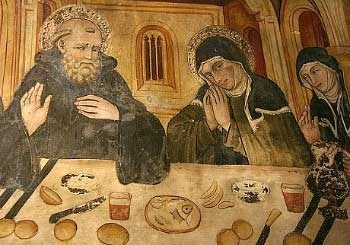
Scholastica, the twin sister of St. Benedict, consecrated her life to God when she was very young. After her brother established his monastery at Mount Cassino, she resided in the neighborhood at Plombariola, about five miles from where her brother lived.

Scholastica founded a monastery of nuns that was governed by Benedict, though still under her own direction.

She visited her brother once a year, and as she was not allowed to enter his monastery, he went with a few of his brothers to meet her at a house some distance away to pray together and speak of spiritual matters.

Saint Benedict and Saint Scholastica

On one such occasion in 543, they had passed the time as usual in prayer and holy conversation and in the evening sat down to eat supper. Scholastica begged her brother to remain until the next day, deviating from their usual custom, so that they might continue their conversation. Benedict refused to spend the night outside his monastery as it was contrary to his order’s rule.

Scholastica turned to God in prayer, and a thunderstorm erupted. The rain and lightning was so violent, that Benedict and his companions were prevented from returning home. "May God forgive you, sister" said Benedict, "for what you have done." "I asked a favor of you," she replied simply, "and you refused it. I asked it of God, and He has granted it!" Thus, they spent the night speaking of holy things.

In the morning, they parted ways, never to see one another on earth again: just three days later, Scholastica died.

Wednesday, February 9, 2022

The Only Thing That Could Save You

When Saint Francis Borgia (1510-1572) was in Rome, a cleric came to speak with him. The saint, being busy with many things, sent his good friend, Father Acosta to see him.

The cleric said to him: "Father, I am a priest and a preacher, but I live in sin, and distrust the divine mercy. A most amazing thing has just happened to me. After preaching a sermon against the stubborn, who afterwards despair of pardon, a person came to me to make his confession. This stranger then narrated to me all my sins, and at length told me that he despaired of the divine mercy! In order to do my duty, I told him that he must change his life, and trust in God. At that very moment, he rose to his feet and reproached me, saying: ‘you, who preach thus to others, why do you not amend, and why do you distrust? Know, that I am an angel come to your aid; amend and you will be pardoned.’”

The priest continued, “When he had said this, he disappeared. I abstained for several days from my sinful practices, but when temptation came I again returned to my sins.

On another day, as I was celebrating Mass, Jesus Christ sensibly spoke to me from the Host, and said: 'Why do you thus maltreat me, when I treat you so well?' After this I resolved to amend, but at the next temptation fell again into sin.”

Shaking his head in sorrow, the cleric continued, “A few hours ago, a youth came to me in my apartment, and drew from under his mantle a chalice, and from this a consecrated Host, saying: 'Do you know this Lord Whom I hold in my hand? Do you remember how many favors he has done you? Now behold the punishment of your ingratitude,' and saying this he drew a sword to kill me.

I then cried out: 'For the love of Mary do not kill me, for I will indeed amend.' Replacing the sword from where it was drawn, he replied: 'This was the only thing that could save you: make a good use of this grace, for this is the last mercy for you.' Then he left me, and I came immediately here, begging you to receive me among you."

Father Acosta consoled him, and the priest, by the advice also of Saint Francis, entered another order of strict observance, where he persevered in holiness till his death.

From the Glories of Mary, by St. Alphonsus Maria de Liguori.

Love implies sacrifice


Love is not just an affirmation,
but a negation.
It implies sacrifice – a surrender of our will,
of our selfish interests, for the good of the other.
It looks not to the lover’s pleasure, but to the happiness of the beloved.

Archbishop Fulton J. Sheen

Saint Michael Febres Cordero


Feast February 9

Michael was born in Cuenca, Ecuador in 1854 to a wealthy family. From birth he had a deformity that disabled him and prevented him from walking.

One day, as he sat in his wheelchair, he saw a rose in the garden. Above the flowers, he saw a beautiful lady wearing a white and blue dress, calling his name. His family, who could see nothing other than the rose, were astonished when he proceeded to get up and walk. From then on, Michel spoke with Our Lady and Jesus on a regular basis.

Saint Michael Febres Cordero

When the De LaSalle Brothers arrived in Ecuador in 1863 and set up a seminary, Michael enrolled, though his parents objected to his plans to become a lay brother rather than a priest.

Instead, they sent him to the seminary where his father taught, but within a few months he became seriously ill and had to return home.

His mother finally agreed to let him become a lay brother. In 1868, Michael entered the order of the De LaSalle Brothers and a year later was assigned to the Beaterio, a congregation of lay sisters dedicated to prayer and charitable work in Quito, where he specialized in preparing children for their First Communion for the next 26 years.

Transferred to Spain to assist in the translation of sacred documents, he caught a cold that developed into pneumonia, and he died on February 9, 1910. His body was returned to Ecuador, and his tomb in Quito soon became a shrine and place of pilgrimage.

The Ecuadorian government issued stamps bearing his likeness and erected a bronze and marble monument to him in Quito’s central park.

Upon the statue’s dedication in June, 1965, there was a huge parade in which 30,000 school children participated.

Tuesday, February 8, 2022

Where is the proof of love?


The proof of love is in the works.
Where love exists, it works great things.
But when it ceases to act, it ceases to exist.

St. Gregory the Great